
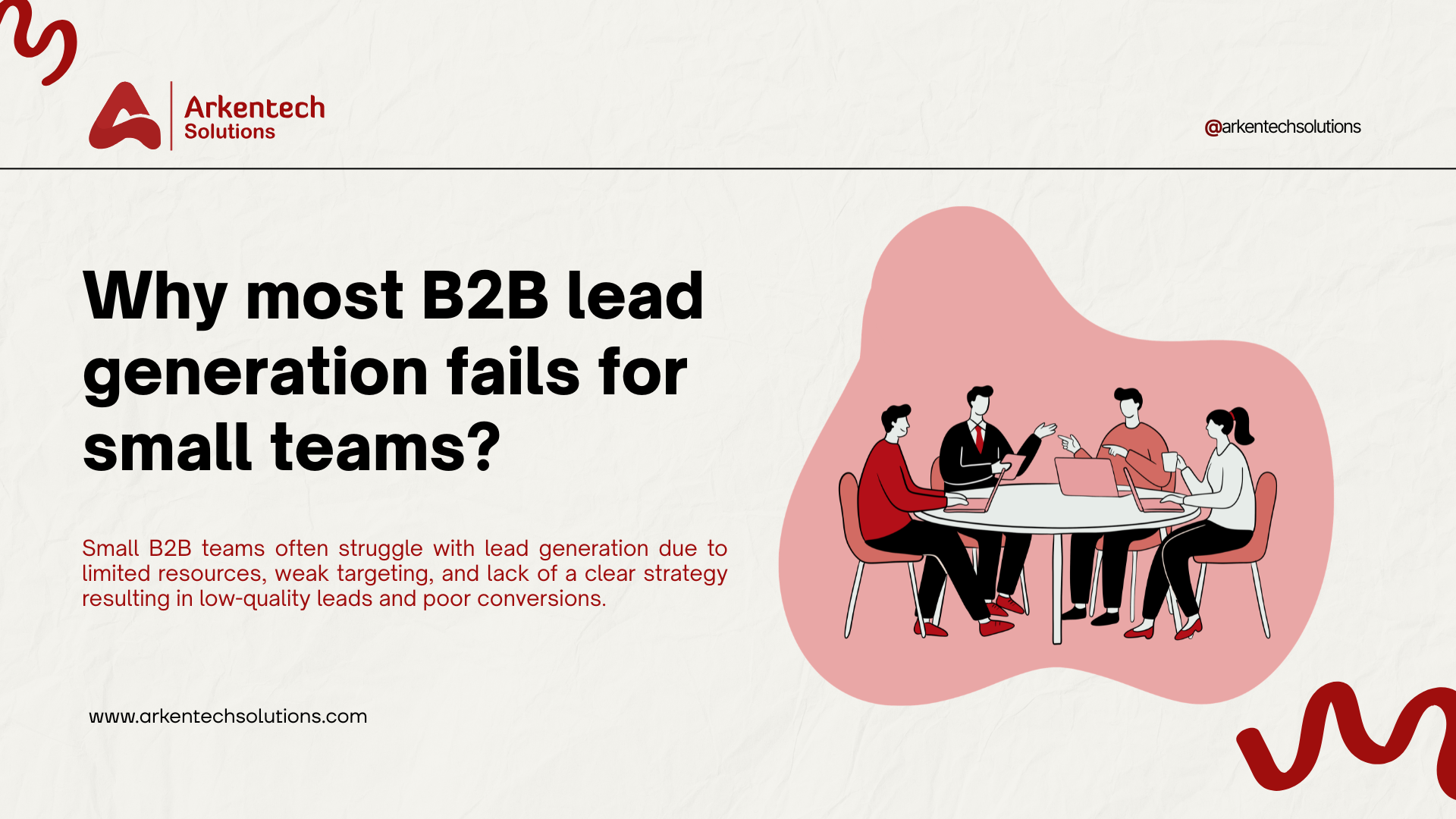
B2B lead generation teams don’t usually fail because they don’t work hard, invest in technology, or have the right resources. They fail because the system is set up to achieve the wrong thing.
Small teams are forced to produce more leads faster and cheaper, but the objective of B2B marketing should not be to generate leads, it should be to generate pipeline and revenue. This results in good looking dashboards, great reports, and successful campaigns, but poor sales conversions.
Most small teams lose momentum in the gap between lead and revenue generation. The key problem is that most B2B lead generation doesn’t work for small teams because they focus on quantity over quality, and lack a pipeline system that supports a revenue-driven, intent-based lead generation strategy.
The Hidden Reality Behind B2B Lead Generation Failure
At a surface level, many campaigns seem to work. Leads are flowing, cost per lead seems acceptable and marketing is busy. But when the leads get to the next level, things go awry. Sales teams begin to screen leads. Leads don’t match the ideal customer profile.
Some don’t have the authority to buy. Others may not be from eligible companies. Some may not even recall interacting with the content.
This leads to a large rejection rate. What appears to be good performance leads to a poor pipeline. This is very common for small teams as they do not have the systems, data or processes to maintain lead quality.
The Core Problem: Optimizing for Leads Instead of Revenue
Small teams’ biggest error is optimizing for leads. Lead generation is just the beginning of a long journey. Cost-per-lead campaigns are more likely to result in poor quality leads.
While casting a wider net, less targeted messaging and shorter forms boost quantity, they diminish quality. This results in a lead pipeline of contacts, not opportunities.
Marketers focused on revenue think differently. They assess their performance by how many leads they successfully convert into sales conversations and ultimately sales.
This leads to a different approach to target, content, and channel. When small teams don’t make the shift, they scale their inefficiency.
Where B2B Lead Generation Breaks Down
Weak Targeting and Undefined ICP
Small teams often don’t have a well-defined ideal customer profile.
Rather than reaching the right accounts, they reach as many accounts as possible. This results in a disconnect between sales and marketing.
Marketing might find and generate leads from all kinds of industries, company types and roles, but sales want highly targeted leads. This lack of consensus on ideal buyer results in poor lead quality.
Absence of Intent Data
Modern B2B buying behavior is driven by intent. Buyers research extensively before engaging with vendors. High-performing teams track these signals and prioritize prospects who show active interest.
Small teams often rely on static databases or basic targeting filters. They miss behavioral signals such as content consumption, search activity, and engagement patterns. As a result, they reach out to prospects who are not ready to buy.
This significantly reduces conversion rates and wastes resources.
Content That Doesn’t Match Buyer Stage
Content plays a critical role in lead generation, but it is often misused. Small teams tend to create generic assets that are distributed across all audiences without considering buyer intent.
A prospect in the early research stage needs educational content, while a decision-stage buyer needs detailed comparisons or case studies. When this alignment is missing, engagement drops and leads lose relevance.
Content should guide the buyer journey, not interrupt it.
Lack of Qualification Process
One of the most common reasons for failure is the absence of a proper qualification layer. Leads are captured and immediately passed to sales without validation.
This creates friction. Sales teams spend time filtering leads instead of engaging with qualified prospects. Over time, trust between marketing and sales deteriorates.
A structured qualification process, including validation and verification, ensures that only relevant leads move forward. Without it, even high-volume campaigns fail to produce results.
Over-Reliance on Single Channels
Small teams often depend on one or two channels, such as paid ads or email campaigns. While these channels can generate leads, they are not sufficient to support the entire buying journey.
B2B decision-making is multi-touch and involves multiple stakeholders. Successful strategies combine different channels to build awareness, nurture engagement, and drive conversion.
Limiting efforts to a single channel reduces both reach and effectiveness.
Lead Volume vs Pipeline Quality
The difference between a failing and a successful strategy can be understood through a simple comparison.
| Metric | Lead Volume Approach | Pipeline Quality Approach |
|---|---|---|
| Primary Focus | Number of leads generated | Revenue and opportunities |
| Targeting Strategy | Broad and generic | ICP-driven and account-focused |
| Lead Relevance | Low to moderate | High |
| Conversion Rate | Low | High |
| Sales Acceptance | Weak | Strong |
| ROI | Inconsistent | Predictable |
This comparison highlights a key insight. Generating more leads does not automatically lead to better results. In many cases, it creates additional inefficiencies.
The Funnel Gap: MQL to Pipeline Breakdown
One key problem with B2B lead generation is the disconnect between the point where a lead is deemed marketing qualified and the point where a pipeline is created. Very small teams tend to stop measuring after lead generation.
But these steps are the most critical. Leads need to be qualified, nurtured and turned into conversations. Without these stages, teams will not know where the conversion process is not working.
For instance, a campaign might generate many leads, but if only a small fraction of these leads are converted into sales-qualified leads, it is a failure. This knowledge is critical to improving performance.
Why Sales and Marketing Misalignment Destroys Results
Alignment between marketing and sales is critical for success, yet it is often missing in small teams. Marketing teams focus on generating leads, while sales teams focus on closing deals.
Without a shared definition of what constitutes a qualified lead, both teams operate with different expectations. This leads to frustration and inefficiency.
When sales teams reject leads, marketing may assume that the issue lies in follow-up, while sales may believe that the leads are irrelevant. This disconnect prevents improvement and slows down growth.
Effective teams establish clear criteria for lead qualification and maintain continuous feedback loops to refine their approach.
The Pipeline-First Framework That Works
To overcome these challenges, small teams need to adopt a structured approach that prioritizes pipeline creation over lead generation. This approach focuses on quality, intent, and alignment.
The process begins with identifying target accounts that match the ideal customer profile. Instead of targeting broad audiences, efforts are concentrated on accounts with the highest potential value.
Next, intent signals are used to identify prospects who are actively researching or engaging with relevant topics. This ensures that outreach efforts are timely and relevant.
Content is then used strategically to engage prospects at different stages of the buying journey. Rather than using generic assets, content is tailored to specific needs and decision points.
A multi-touch engagement strategy ensures that prospects are nurtured through different channels, including email, content syndication, and direct outreach. This increases the likelihood of conversion.
Finally, a robust qualification process ensures that only high-quality leads are passed to sales. This improves efficiency and increases the chances of closing deals.
Real-World Funnel Example
Consider a campaign that generates 1,000 leads. Without proper targeting and qualification, a large portion of these leads may be irrelevant.
After filtering, only 300 leads may qualify as marketing-qualified leads. From these, 120 may be accepted by sales as sales-qualified leads. Out of those, 45 may convert into opportunities.
This example highlights an important point. The value of a campaign is not determined by the number of leads generated but by the number of opportunities created.
Small teams that focus only on lead volume often overlook this reality.
The Shift from Lead Generation to Demand and Pipeline Generation
The B2B landscape is evolving. Traditional lead generation strategies are being replaced by B2B demand generation services and pipeline-focused approaches.
Demand generation focuses on creating awareness and interest among potential buyers. It builds long-term relationships and positions the brand as a trusted resource.
Pipeline generation goes a step further by ensuring that these relationships translate into measurable business outcomes. It connects marketing efforts directly to revenue.
Small teams that embrace this shift are better positioned to compete, even with limited resources.
Channel Performance and ROI Comparison
Different channels contribute differently to pipeline creation. Understanding their impact helps teams allocate resources effectively.
| Channel | Typical Cost Per Lead | Lead Quality | Pipeline Contribution |
|---|---|---|---|
| Paid Ads | Low to moderate | Moderate | Medium |
| Email Marketing | Low | Low to moderate | Low |
| Content Syndication | Moderate | High | High |
| Account-Based Marketing | High | Very high | Very high |
| Tele-Qualification | Moderate | Very high | High |
This comparison shows that focusing only on cost can be misleading. Channels that generate higher-quality leads often deliver better long-term ROI.
How High-Performing Teams Generate Pipeline
Successful teams follow a different approach. They focus on alignment, data and process. They prioritise audience research and apply it to their decision-making.
They measure success all the way down the funnel. They continually optimise their targeting, messaging and processes. Finally, they emphasise results over actions. All campaigns are built with one end goal: pipeline and revenue.
Data-Backed Insight That Explains the Failure
Market research frequently addresses the difficulties in generating B2B leads. Research from firms such as HubSpot show a large proportion of marketers are grappling with lead quality and lead conversion. Likewise, McKinsey’s research focuses on the need for a revenue mindset in marketing.
Such research drives home a point. Lead quantity doesn’t matter. If not linked to pipeline and revenue, busy campaigns are not effective.
The Most Effective Strategy Moving Forward
The best way to drive high-quality leads for B2B is to merge intent data and first-party engagement data with multi-channel demand generation for a united approach to pipeline.
This strategy covers all buyer journey steps, from awareness to conversion. It also leads to a scalable platform.
Combined Buyer Questions and Search Intent Explained
Decision-makers have common questions when it comes to assessing B2B lead generation performance. They are looking for ways to improve their campaigns and reach better results.
The key is to focus on quality, not quantity. Rather than “how many leads?”, they must ask themselves “how many qualified leads?”. Another question is how to improve lead quality. This can be achieved through improved targeting, leveraging intent data, matching content to buyer personas and having a robust lead qualification process.
Another question is whether small teams can go head-to-head with large enterprises. Yes, as long as they are disciplined in their approach. Small teams can generate big leads by targeting their efforts on high value accounts, and by using data to fuel their campaigns.
Final Perspective
B2B lead generation is not a bad thing. It fails because it is typically done with the wrong focus. Small marketing teams who focus on lead generation without pipeline and revenue will struggle.
But those that prioritise pipeline can improve their results. The teams that will succeed in B2B marketing are those with a strong grasp of intent, alignment and execution.
By creating processes that bridge marketing and revenue, they will be able to grow and prosper.