
Over the past few years, B2B marketing has greatly developed. Conventional marketing methods that emphasize the ability to address masses of people are no longer efficient because a modern buyer now demands to be communicated with personally and offered relevant solutions when he or she decides to communicate with a brand.
In the world of today, decision makers do a lot of research before getting in touch with vendors. They want a company that is aware of their business problems and offer specific solutions instead of a general marketing message.
Due to this change, Account Based Marketing (ABM) is becoming a popular method of demand creation and revenue generation in many organizations. Rather than attempting to create thousands of leads, Account Based Marketing concentrates on the identification of high-value target companies and developing unique marketing campaigns that are specifically oriented on them.
This direct methodology enables companies to establish closer relationships, enhance interactivity, and enhance the rate of conversion.
Industry analysis indicates that more than 80 percent of B2B marketers believe that Account Based Marketing yields a greater ROI than conventional marketing mechanisms. Because of that, ABM is turning into one of the most significant expansion tactics of the contemporary B2B businesses.
This guide will give the explanation on how companies are able to create a successful Account Based Marketing planning strategy, conduct campaigns, and gauge results effectively.
What is Account Based Marketing?
Account Based Marketing (ABM) is a B2B marketing strategy that focuses on targeting specific high-value companies rather than broad audiences. In this approach, each company is treated as its own market, and marketing campaigns are tailored to the needs of that organization.
Instead of focusing on lead volume, ABM emphasizes quality engagement with strategic accounts that have a higher probability of becoming customers.
Key Elements of Account Based Marketing
| Element | Explanation |
| Targeted Accounts | Companies selected because they match an ideal customer profile |
| Personalized Marketing | Messaging and campaigns customized for specific organizations |
| Sales and Marketing Alignment | Collaboration between sales and marketing teams |
| Data-Driven Insights | Use of data and analytics to identify buying signals |
| Revenue Focus | Success measured through pipeline and revenue growth |
This focused approach enables businesses to connect with decision makers more effectively and improve their chances of closing high-value deals.
Why B2B Companies Are Adopting Account Based Marketing
Many B2B organizations are moving toward ABM because it provides measurable business benefits compared to traditional marketing methods.
Rather than generating a large number of unqualified leads, ABM helps businesses engage with companies that are most likely to convert.
Benefits of Account Based Marketing
| Benefit | Description |
| Higher ROI | Marketing resources are focused on accounts with strong revenue potential |
| Better Lead Quality | Fewer leads but higher conversion potential |
| Larger Deal Sizes | Enterprise accounts often generate higher contract values |
| Faster Sales Cycles | Personalized communication accelerates decision making |
| Stronger Customer Relationships | Businesses build long-term partnerships with target accounts |
Companies that adopt ABM strategies often experience improved pipeline quality and stronger engagement with decision makers.
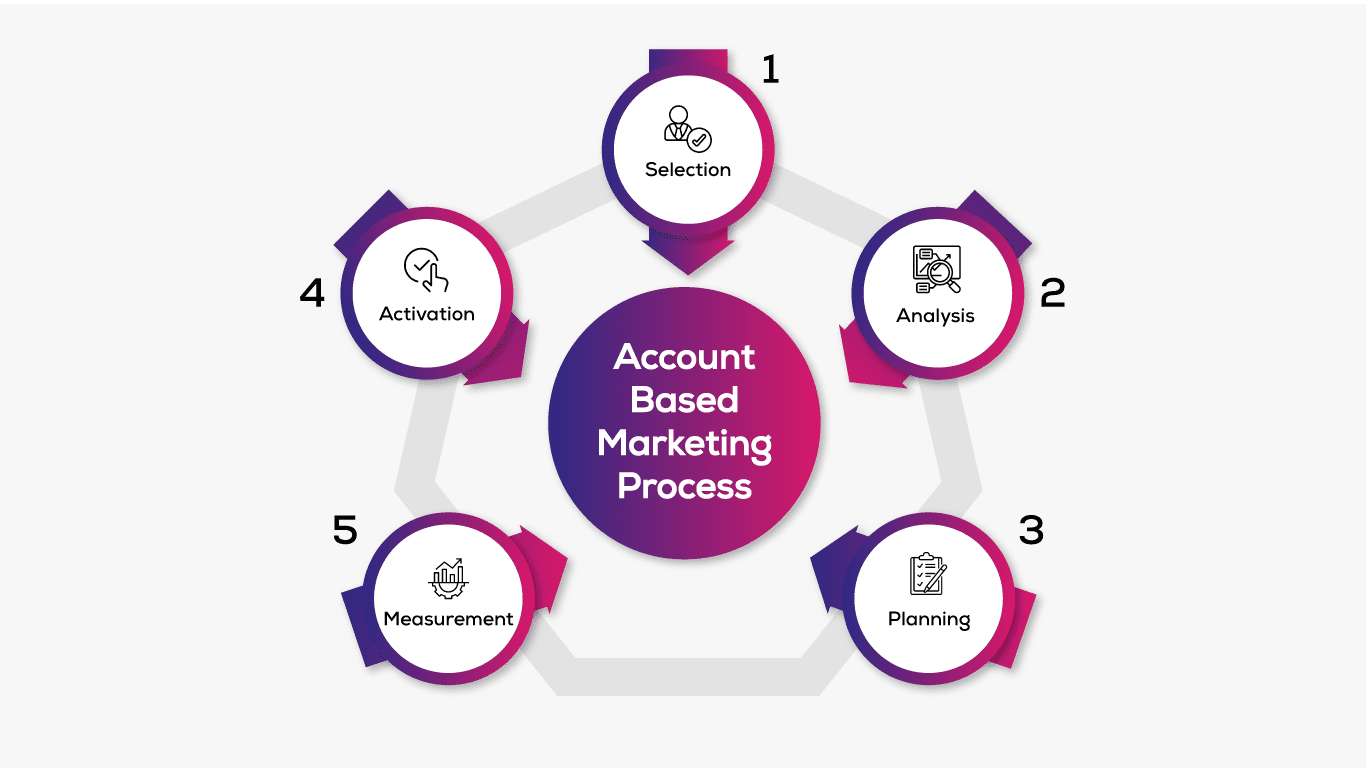
Step-by-Step Account Based Marketing Planning Framework
Implementing Account Based Marketing requires a structured approach. The following framework can help businesses build a successful ABM strategy.
Account Based Marketing Planning Process
| Step | Action |
| Step 1 | Define Ideal Customer Profile (ICP) |
| Step 2 | Build Target Account List |
| Step 3 | Align Sales and Marketing Teams |
| Step 4 | Research Target Accounts |
| Step 5 | Develop Personalized Campaigns |
| Step 6 | Execute Multi-Channel Engagement |
| Step 7 | Measure Campaign Performance |
Each step plays an important role in ensuring the success of an ABM program.
Step 1: Define Your Ideal Customer Profile (ICP)
The first step in any Account Based Marketing strategy is defining your Ideal Customer Profile (ICP).
An Ideal Customer Profile describes the type of company that is most likely to benefit from your product or service.
Important Factors When Defining an ICP
| Factor | Example |
| Industry | SaaS, FinTech, Manufacturing |
| Company Size | 500+ employees |
| Annual Revenue | $50M+ |
| Region | North America, Europe |
| Technology Environment | Cloud platforms or enterprise software |
Defining your ICP ensures that marketing resources are focused on companies with the highest revenue potential.
Step 2: Identify Target Accounts
After defining the ICP, the next step is building a Target Account List (TAL).
This list includes companies that match the criteria of your Ideal Customer Profile and represent potential opportunities for your business.
Example Target Account List
| Company | Industry | Employees | Region |
| Company A | FinTech | 1,200 | USA |
| Company B | SaaS | 850 | UK |
| Company C | Manufacturing | 2,000 | Germany |
Businesses often use CRM systems, market research, and intent data platforms to identify these accounts.
Step 3: Align Sales and Marketing Teams
One of the most important factors in ABM success is strong collaboration between sales and marketing teams.
In traditional marketing models, these teams often operate separately. However, Account Based Marketing requires them to work closely together.
Roles in an ABM Strategy
| Team | Responsibility |
| Marketing Team | Campaign creation, content development, account research |
| Sales Team | Relationship building, meetings, closing deals |
| Data/Analytics Teams | Tracking engagement and performance |
When these teams collaborate effectively, businesses can create more targeted engagement strategies.
Step 4: Research Target Accounts
Successful ABM campaigns depend on a deep understanding of the target company.
Businesses should research several aspects of each account:
- Business objectives
- Industry challenges
- Technology environment
- Key decision makers
- Buying behavior
This information allows marketers to create messaging that directly addresses the needs of the target company.
Step 5: Develop Personalized Campaigns
Personalization is the foundation of Account Based Marketing.
Generic marketing messages rarely capture the attention of enterprise decision makers. Instead, businesses need to deliver relevant content that addresses specific challenges faced by their target accounts.
Examples of Personalized ABM Campaigns
| Strategy | Example |
| Custom Landing Pages | Pages designed specifically for target companies |
| Targeted LinkedIn Ads | Ads shown to executives within selected organizations |
| Personalized Emails | Outreach referencing company challenges |
| Industry Reports | Content tailored for specific sectors |
These personalized experiences increase engagement and build trust with potential customers.
Step 6: Multi-Channel Engagement
Effective ABM campaigns use multiple communication channels to reach decision makers.
Common ABM Channels
| Channel | Purpose |
| Email Marketing | Direct communication with decision makers |
| LinkedIn Advertising | Target executives and professionals |
| Content Marketing | Provide valuable insights and resources |
| Webinars and Events | Build relationships and educate prospects |
| Retargeting Ads | Maintain visibility with target accounts |
Using multiple channels ensures consistent engagement across the buying journey.
Step 7: Measure ABM Performance
Tracking performance is essential to understanding whether an ABM strategy is delivering results.
Important ABM Metrics
| Metric | Meaning |
| Account Engagement | Interaction with content and campaigns |
| Pipeline Value | Revenue opportunities generated |
| Win Rate | Percentage of deals successfully closed |
| Average Contract Value | Average deal size |
| Customer Lifetime Value | Total revenue from a customer over time |
Monitoring these metrics helps businesses refine their strategy and improve campaign performance.
Technologies That Support Account Based Marketing
Modern ABM strategies rely on several technologies to manage campaigns and analyze data.
Key ABM Technologies
| Technology | Function |
| CRM Platforms | Manage accounts and track sales activity |
| Marketing Automation Tools | Email campaigns and nurturing |
| Intent Data Platforms | Identify buying signals |
| Advertising Platforms | Target specific companies |
| Analytics Tools | Measure engagement and ROI |
These technologies help businesses automate processes and gain insights into account behavior.
Challenges in Implementing Account Based Marketing
Although ABM offers many advantages, businesses may encounter several challenges when implementing this strategy.
Common ABM Challenges
| Challenge | Explanation |
| Data Quality Issues | Inaccurate or incomplete data affects targeting |
| Limited Personalization | Creating customized campaigns requires time |
| Sales-Marketing Misalignment | Teams may not collaborate effectively |
| ROI Measurement | Linking campaigns directly to revenue can be complex |
Overcoming these challenges requires strong planning and collaboration across teams.
The Future of Account Based Marketing
Account Based Marketing continues to evolve as technology advances and customer expectations change.
Emerging technologies such as artificial intelligence, predictive analytics, and intent data platforms are making ABM strategies more effective.
Key Trends in ABM
| Trend | Impact |
| AI-Driven Targeting | More accurate account identification |
| Predictive Analytics | Better forecasting and sales insights |
| Intent Data | Early identification of buying signals |
| Hyper-Personalized Campaigns | Highly customized marketing experiences |
Businesses that adopt these technologies will gain a competitive advantage in the evolving B2B marketing landscape.
Conclusion
Account Based Marketing has become one of the most effective strategies for B2B organizations seeking to generate predictable revenue and build stronger relationships with customers.
By focusing marketing efforts on high-value accounts, aligning sales and marketing teams, and delivering personalized engagement, companies can significantly improve conversion rates and deal sizes.
Although implementing an ABM strategy requires planning and collaboration, the long-term benefits are substantial. Businesses that invest in targeted, data-driven marketing approaches will be better positioned to compete in the modern B2B marketplace.
As the demand for personalized experiences continues to grow, Account Based Marketing will remain a critical component of successful B2B marketing strategies.
FAQ: Account Based Marketing
What is Account Based Marketing?
Account Based Marketing is a B2B strategy where companies focus markeing efforts on specific high-value accounts instead of broad audiences.
Why is ABM important for B2B companies?
ABM improves lead quality, increases deal size, and helps businesses build stronger relationships with decision makers.
Which industries use Account Based Marketing?
Industries such as technology, SaaS, finance, consulting, and enterprise services commonly use ABM strategies.
How do companies measure ABM success?
Success is measured using metrics such as account engagement, pipeline value, win rate, and customer lifetime value.