
B2B marketing budgets are under stress now. Businesses are cautious about spending. They want proof of return on investment. They also face harder to predict deal cycles. Marketing teams are asked to do things. They must create pipeline. They must support sales. They must keep customers. They must boost brand visibility. They are asked to use intelligence. They often do not get money to do all these tasks.
The situation is tough. Marketers are expected to do more. They must prove the money value of every action. In companies leadership still believes in marketing.. The definition of good marketing is changing. Spending that does not show a link to business outcomes is harder to defend. Investments that help demand, customer relationships, pipeline creation and revenue get more attention.
The pressure is also connected to a broader change in how B2B companies evaluate growth. During periods of aggressive expansion, organizations may tolerate inefficient acquisition costs because the priority is market share and rapid growth. When economic conditions become less predictable, the focus tends to shift toward efficiency, profitability, customer lifetime value, retention, and predictable pipeline.
Marketing is therefore being evaluated less as a collection of campaigns and more as a business growth function. This shift can make budgets feel smaller even when the underlying problem is not simply the amount of money available. A $1 million marketing budget with poor measurement can be less valuable than a $600,000 budget allocated to the right audiences, channels, content, technology, and customer opportunities.
For B2B companies the challenge is big. Buying decisions rarely come from one person. Buying committees include executives, finance teams, technical stakeholders, procurement, operations, security and end users. Marketing must influence people at different buying stages. Sales teams must turn that interest into conversations.. Then into revenue. This makes B2B marketing different, from a sale model.
What Is Really Driving Pressure on B2B Marketing Budgets?
There is no single reason why businesses are becoming more conservative with marketing expenditure. Budget pressure is usually the result of several factors happening at the same time. Companies are facing demands for efficiency buyer journeys that are more split up technology costs that climb search habits that shift, pressure on the cost of getting new customers and more scrutiny from bosses and finance people.
At the time digital marketing has gotten more complex. A B2B buyer might find a company by searching then see its content on LinkedIn read reviews from others ask an AI for suggestions watch a webinar talk with a salesperson compare rivals and only come back after months before turning into a deal. Because of this marketing teams must work across touchpoints and they must also show which actions lead to the final result.
The table below summarizes some of the biggest forces affecting B2B marketing budgets.
| Budget Pressure | What It Means for Marketing Teams | Business Impact |
|---|---|---|
| Economic uncertainty | Leadership becomes more cautious about discretionary spending | Greater budget scrutiny |
| Rising acquisition costs | More money may be required to generate comparable demand | Lower efficiency |
| Longer sales cycles | Pipeline can take longer to convert | Delayed revenue |
| Complex buying committees | More stakeholders need to be influenced | Higher content and engagement requirements |
| AI disruption | Traditional search and content discovery are changing | New investment requirements |
| Technology overload | Companies accumulate too many marketing tools | Higher operating costs |
| Poor attribution | Teams struggle to prove what generated revenue | Budget becomes harder to defend |
| Low-quality leads | High lead volume does not necessarily create opportunities | Wasted sales resources |
| Channel saturation | Buyers encounter enormous amounts of marketing content | Lower engagement |
| Revenue pressure | Executives expect marketing to contribute directly to growth | Greater accountability |
These pressures do not automatically mean that marketing should receive less investment. In many cases, they mean that businesses need to become more selective about where the investment goes.
A company that responds to budget pressure by cutting every channel equally may create a bigger problem. The company could remove the content that generates traffic reduce the campaigns that create qualified demand stop customer programs that support retention and weaken brand visibility at the exact moment competitors are increasing their presence.
A smarter approach is to identify activities that create measurable business value and protect them while reducing inefficient spending.
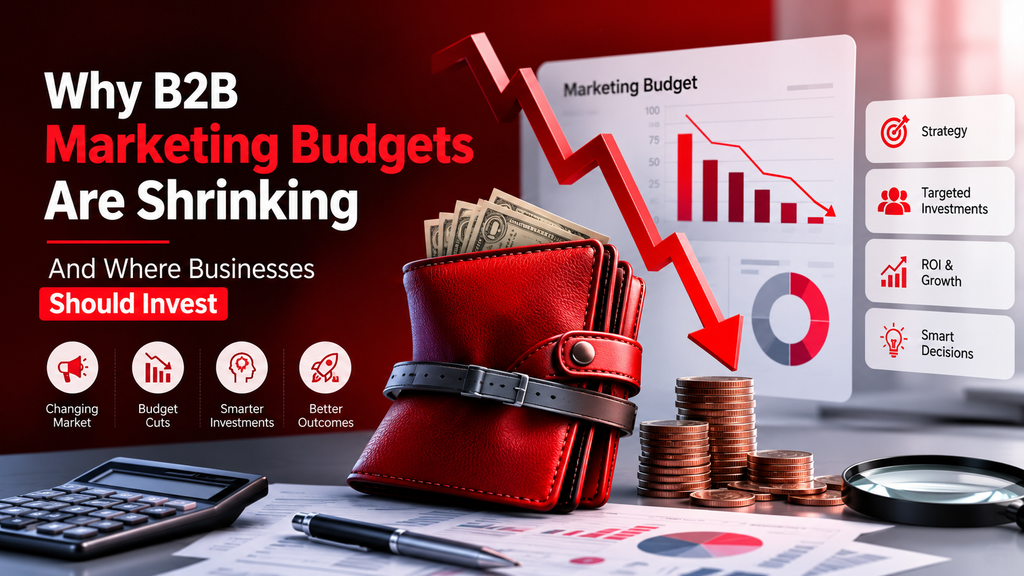
The Problem With Cutting Marketing Too Quickly
One of the biggest mistakes businesses can make when budgets tighten is treating marketing as a cost center that can simply be reduced by a fixed percentage. Cutting 20% from every marketing activity may look fair on a spreadsheet, but customer demand does not work according to spreadsheet symmetry.
Some marketing investments produce immediate results. Others take months to generate measurable returns. Some influence existing demand, while others create demand that did not previously exist. Some activities support sales directly, while others build brand recognition that makes future sales conversations easier.
Removing an activity without understanding its role can therefore create hidden costs.
For example, reducing content production might lower monthly expenses immediately, but it can also reduce organic search visibility, decrease the number of assets available to sales teams, weaken AI-search visibility, and create fewer opportunities for prospects to educate themselves. Similarly, reducing customer marketing may save money in the short term while increasing churn or reducing expansion opportunities.
This is why budget optimization should not be confused with budget reduction.
Budget optimization means moving money from low-value activities toward higher-value activities.
That requires marketers to evaluate spending based on several dimensions:
| Question | Why It Matters |
|---|---|
| Does this activity reach the right audience? | Audience quality matters more than raw reach |
| Does it create meaningful engagement? | Engagement can indicate interest |
| Does it contribute to qualified pipeline? | Pipeline connects marketing to revenue |
| Does sales actually use the output? | Unused marketing assets create limited value |
| Can performance be measured? | Measurement improves budget decisions |
| Does it strengthen long-term demand? | Not every investment produces immediate revenue |
| Can technology improve efficiency? | Automation can reduce repetitive work |
| Does it support customer retention? | Existing customers can be valuable growth opportunities |
| Does it differentiate the business? | Differentiation improves competitive positioning |
A smaller budget can therefore become more powerful when the organization understands what each dollar is supposed to accomplish.
Where Should Businesses Invest Their Marketing Budget?
When B2B marketing budgets are under pressure, businesses should prioritize investments that improve demand quality, customer understanding, content authority, sales alignment, operational efficiency, and measurable revenue contribution.
This does not mean every company should follow exactly the same allocation model. A startup trying to establish category awareness will have different priorities from an established enterprise trying to increase expansion revenue. A company selling complex cybersecurity infrastructure will also have different requirements from a SaaS company selling a low-cost productivity platform.
However, several investment categories are becoming increasingly important across B2B organizations.
| Investment Area | Primary Goal | Priority |
|---|---|---|
| High-intent demand generation | Capture active buying interest | Very High |
| Content and thought leadership | Build authority and educate buyers | Very High |
| AI marketing infrastructure | Improve productivity and personalization | High |
| First-party data | Understand prospects and customers | High |
| Account-based marketing | Focus resources on valuable accounts | High |
| Sales and marketing alignment | Improve pipeline conversion | Very High |
| Customer marketing | Increase retention and expansion | High |
| Brand building | Improve recognition and trust | Medium–High |
| Experimental channels | Discover new opportunities | Controlled |
| Low-intent mass acquisition | Generate volume | Lower |
The important point is not to eliminate experimentation. Instead, businesses should create a balance between proven investments and controlled experimentation.
Invest in High-Intent Demand Generation
One of the strongest places for B2B companies to focus limited marketing budgets is high-intent demand generation.
Traditional lead generation often focuses on volume. Marketers may celebrate thousands of downloads webinar registrations, form submissions or advertising leads.. Volume alone does not tell a business whether buyers are actually interested in purchasing.
A smaller marketing budget makes this distinction even more important.
If a company generates 10,000 low-quality leads and only a small percentage become sales opportunities the organization may spend money on sales follow‑up lead nurturing, data cleaning and qualification than it would have spent targeting a smaller number of high‑intent prospects.
High-intent demand generation takes a different approach. Instead of asking only how many people entered the funnel, it asks whether the people entering the funnel have a genuine business need.
This means marketers should pay attention to signals such as:
- Repeated visits to high-value product pages
- Pricing or comparison research
- Product documentation engagement
- Demo or consultation activity
- High-value content consumption
- Webinar participation
- Account-level engagement
- Sales conversations
- Product trials
- Repeat website activity
- Engagement from multiple people within the same account
The goal is not simply to identify someone who clicked.
The goal is to identify business interest.
Key Points
- Prioritize buying intent over lead volume.
- Focus budget on audiences that resemble your highest-value customers.
- Connect marketing signals with sales activity.
- Use account-level information when individual lead data is insufficient.
- Measure qualified pipeline instead of relying only on marketing-generated leads.
Build a Stronger Content Strategy
When budgets shrink, some companies immediately reduce content production because content can appear less directly connected to revenue than paid campaigns. That can be a mistake.
Content is becoming more important because buyers increasingly conduct research before speaking with sales. They want answers to questions about products, vendors, risks, pricing, implementation, integrations, security, performance and business outcomes.
The challenge is that producing more content does not automatically create more value.
B2B companies need better content rather than simply more content.
A strong content strategy should address different stages of the buyer journey.
| Buyer Stage | Content Objective | Useful Content |
|---|---|---|
| Awareness | Explain problems and trends | Guides, research, articles |
| Education | Help buyers understand solutions | Deep-dive articles, webinars |
| Consideration | Compare approaches | Comparison pages, frameworks |
| Evaluation | Reduce purchase uncertainty | Case studies, technical resources |
| Decision | Support internal justification | ROI content, implementation guides |
| Adoption | Help customers succeed | Documentation, training |
| Expansion | Identify additional value | Use-case content, customer resources |
The biggest content mistake is often creating material based entirely on what the company wants to say.
Effective B2B content starts with what buyers need to understand.
Instead of publishing another generic article about “the benefits of digital transformation,” businesses can build content around more specific questions: how to evaluate vendors, how to calculate implementation costs, how to compare solutions, what risks to consider, what internal teams need to prepare, and how to measure outcomes.
This type of content can perform across traditional search, social discovery, sales conversations, and AI-assisted research.
Make AI a Marketing Productivity Layer
Artificial intelligence is another area where businesses need to think carefully about investment.
The goal should not be to purchase every new AI marketing tool that appears in the market. The goal should be to determine where AI can improve existing workflows.
AI can potentially help marketing teams with:
- Research
- Content ideation
- Content briefs
- Competitive analysis
- Data analysis
- Audience segmentation
- Lead qualification
- Personalization
- Campaign optimization
- Customer intelligence
- Sales enablement
- Reporting
- Workflow automation
But AI should not become an excuse to produce huge volumes of generic content.
The strongest use of AI is often behind the scenes, where it can help marketers work faster while human teams remain responsible for strategy, positioning, accuracy, creativity, and quality.
| AI Application | Potential Benefit |
|---|---|
| Research assistance | Faster information gathering |
| Content workflows | Faster production and editing |
| Audience analysis | Better segmentation |
| Lead scoring | More efficient prioritization |
| Personalization | More relevant communication |
| Reporting | Faster insight generation |
| Campaign analysis | Better optimization |
| Sales enablement | Faster access to useful content |
| Workflow automation | Less repetitive manual work |
Businesses should therefore evaluate AI investments based on time saved, quality improved, revenue influenced, and operational efficiency rather than simply counting how many AI tools the marketing department owns.

Invest in First-Party Data and Customer Intelligence
As digital marketing grows more scattered first-party data grows more important.
Companies can no longer depend on advertising platforms or third-party data to learn about their customers. They need an internal view of who their prospects are, who their customers are, how accounts act how they engage what they buy how they interact with content and what sales activity happens.
First-party data can help answer important questions:
- Which accounts are engaging with our content?
- Which prospects are showing repeated interest?
- Which customers are most likely to expand?
- Which campaigns influence opportunities?
- Which industries convert best?
- Which customer segments have higher lifetime value?
- Which channels produce qualified opportunities?
This information can make marketing budgets more efficient because it allows teams to focus resources on audiences with stronger potential.
A company that understands its ideal customers can often reduce waste without reducing growth.
That is the real advantage of customer intelligence.
Improve Account-Based Marketing
Account-based marketing can also become more valuable when marketing resources are limited.
Instead of spreading the same budget across a very large audience, ABM allows organizations to identify specific accounts that fit their ideal customer profile and build coordinated programs around them.
This approach is particularly relevant for businesses with:
- High average contract values
- Long sales cycles
- Complex buying committees
- Enterprise customers
- Small addressable markets
- Multiple stakeholders per account
ABM does not mean abandoning broader demand generation. Instead, it gives marketing teams another way to concentrate resources where potential business value is higher.
| Traditional Broad Approach | Account-Based Approach |
|---|---|
| Large audience | Defined target accounts |
| Lead-focused | Account-focused |
| Generic messaging | Account-relevant messaging |
| High volume | Higher relevance |
| Individual engagement | Buying-group engagement |
| Lead metrics | Account and pipeline metrics |
The important consideration is quality.
ABM should not simply become another advertising tactic. It works best when marketing, sales, customer success, and leadership agree on which accounts matter and why.
Strengthen Marketing and Sales Alignment
When budgets shrink, marketing and sales alignment becomes one of the most important areas for improvement.
There is value in marketing generating large numbers of leads if sales does not consider them valuable. Likewise sales teams cannot expect marketing to generate opportunities without providing useful information, about target customers, objections, buying triggers and competitive situations.
Strong alignment begins with shared definitions.
Marketing and sales should agree on:
- Ideal customer profile
- Target industries
- Account priorities
- Qualified lead definitions
- Opportunity definitions
- Pipeline stages
- Lead follow-up expectations
- Revenue goals
- Attribution principles
- Feedback processes
The goal is to create a continuous feedback loop.
Marketing generates insight and demand. Sales provides feedback about buyer quality. Marketing adjusts targeting and messaging. Sales receives better opportunities. Both teams learn from closed and lost deals.
This is especially important when budgets are limited because poor alignment effectively creates marketing waste and sales waste at the same time.
Measure Pipeline Instead of Vanity Metrics
One of the clearest changes businesses can make is moving away from vanity metrics.
Website traffic matters.
Social engagement matters.
Impressions matter.
But none of these metrics should exist in isolation.
A B2B marketing organization should increasingly connect activity with business outcomes.
| Traditional Metric | More Useful Business Question |
|---|---|
| Website traffic | Are the right buyers visiting? |
| Leads | How many are qualified? |
| Downloads | Did content influence buying activity? |
| Social engagement | Did it reach relevant decision-makers? |
| Email opens | Did engagement create meaningful action? |
| MQLs | Did they become sales opportunities? |
| Campaign clicks | Did the campaign influence pipeline? |
| Marketing reach | Did it improve market visibility? |
| Cost per lead | What is the cost per qualified opportunity? |
| Conversion rate | Which audiences convert into revenue? |
A better marketing dashboard should connect the journey from investment → engagement → qualified demand → opportunity → revenue.
Not every marketing activity can be attributed perfectly to revenue. B2B journeys are too complex for that. But the inability to achieve perfect attribution should not become an excuse for having no measurement framework.
Marketing leaders should instead combine quantitative performance data with qualitative evidence from sales teams and customers.
Should Businesses Still Invest in Brand Marketing?
Yes.
But brand investment needs to be understood differently.
When budgets get tight brand marketing is often one of the areas that executives question, because measuring brand marketings money outcome can be hard right away.
The problem is that B2B buyers do not evaluate unfamiliar companies in the same way they evaluate known brands.
- Trust matters.
- Recognition matters.
- Perceived expertise matters.
A buyer who has seen a company times through useful research, industry commentary, thought leadership, events or expert content will talk to the sales team differently than someone who sees that company for the first time.
Brand therefore supports demand generation rather than necessarily competing with it.
A sensible B2B marketing budget should balance short-term pipeline creation with long-term market presence.
| Investment Type | Short-Term Impact | Long-Term Impact |
|---|---|---|
| Performance advertising | High | Medium |
| Demand generation | High | High |
| SEO | Medium | High |
| Thought leadership | Medium | High |
| Customer marketing | High | High |
| Brand campaigns | Low–Medium | Very High |
| Sales enablement | High | Medium |
| Content strategy | Medium | Very High |
The exact mix depends on the company’s growth stage, sales cycle, category, and competitive environment.
How to Allocate a Smaller B2B Marketing Budget
There is no universal percentage allocation that works for every business. However, companies can use a priority-based framework rather than simply dividing their budget equally among channels.
A useful approach is to classify investments into four categories:
1. Protect
These are activities that consistently contribute to pipeline, customers, retention, or strategic visibility.
2. Improve
These activities have potential but require better targeting, measurement, creative, or execution.
3. Experiment
These are new opportunities that should receive controlled funding.
4. Eliminate
These are activities that consistently consume resources without producing meaningful business value.
| Budget Classification | Action |
|---|---|
| Protect | Maintain or increase |
| Improve | Optimize |
| Experiment | Test with limits |
| Eliminate | Reduce or stop |
This framework is more useful than saying, “Every department needs to cut 10%
What Businesses Should Stop Spending On
Budget optimization is not only about deciding where to invest more.
It is also about identifying where money is being wasted.
Common sources of inefficient B2B marketing spending include:
- Campaigns targeting audiences that do not match the ICP
- Content produced without a defined business purpose
- Duplicate marketing technology
- Events without clear post-event follow-up
- Lead generation campaigns optimized for volume alone
- Advertising with weak conversion paths
- Social campaigns that generate engagement but little business value
- Unused software subscriptions
- Excessive reporting without actionable insights
- Campaigns that marketing runs but sales never follows up
- Content that receives traffic but attracts the wrong audience
- Repetitive manual processes that could be automated
The objective is not to eliminate everything that cannot be directly attributed to revenue.
Instead, businesses should ask:
“If we removed this investment, what business capability would we actually lose?”
If the answer is unclear, the investment deserves closer examination.
Key Points for Managing a Smaller Marketing Budget
Key Point 1: Focus on Quality
A smaller budget cannot support unlimited audience expansion. Targeting therefore becomes more important.
Key Point 2: Connect Marketing With Revenue
Marketing should not work in isolation. It needs to understand how campaigns lead to business results. This means tracking how campaigns create leads and move them through the sales pipeline.
Key Point 3: Use AI Carefully
AI can help marketers work faster and make choices.. It should not be used just to create more content. The goal is decisions, not just more content volume.
Key Point 4: Strengthen Owned Channels
Channels like email lists, websites, blogs and social communities are under your control. Investing in them builds long-term value. Reduces reliance on paid ads.
Key Point 5: Invest in Existing Customers
It is often cheaper and easier to keep a customer than to get an one. Existing customers already know the company. They are more likely to buy or refer others.
Key Point 6: Build Reusable Assets
Good content, like research reports, comparison pages, guides, webinars or case studies can be used again and again. These assets support marketing and sales for months or even years.
Key Point 7: Measure What Leadership Cares About
If leadership focuses on revenue then marketing reports should show how marketing activities impact pipeline and revenue. This builds trust. Keeps marketing aligned with company goals.

How to Build a More Efficient B2B Marketing Strategy
A more efficient strategy begins with the customer rather than the channel.
Instead of asking, “Should we spend more on LinkedIn?” or “Should we increase Google Ads?” marketers should first ask where their highest-value buyers spend time, how they research solutions, what information they need, and what causes them to move from research to conversation.
Once those questions are answered, channel decisions become easier.
A practical framework looks like this:
| Step | Question |
|---|---|
| 1. Define ICP | Which companies are most valuable? |
| 2. Understand buyers | Who influences the decision? |
| 3. Map buying journey | What questions appear at each stage? |
| 4. Identify intent | Which behaviors suggest active demand? |
| 5. Build content | What information reduces buyer uncertainty? |
| 6. Select channels | Where can those buyers be reached? |
| 7. Connect sales | How will sales follow up? |
| 8. Measure pipeline | What opportunities are influenced? |
| 9. Optimize | Where should the next dollar go? |
This approach turns marketing from a collection of campaigns into a coordinated growth system.
B2B Marketing Budgets and the Changing Search Landscape
Another purpose for which companies need to rethink their advertising funding is that the way buyers discover data is changing.
While traditional prospecting remains important, buyers are increasingly using AI-powered equipment, expert communities, website evaluation, social networks, industry guides, and various digital resources in the age of research .
In this way, it is conceivable to adapt traditional search engines in front of B2B companies.
Content should be:
- Easy for search engines to understand
- Structured around real buyer questions
- Supported by credible information
- Clear and specific
- Useful without requiring a sales conversation
- Organized into strong topical clusters
- Consistent with the company’s expertise
- Written for both humans and AI-assisted discovery
This is where SEO, AEO, and GEO increasingly overlap.
A business should not create separate content for every new discovery technology. Instead, it should build genuinely useful, authoritative content that can be understood and surfaced across multiple discovery environments.
That makes content investment more durable.
Common B2B Marketing Budget Mistakes
Even experienced marketing teams can make budget allocation mistakes when financial pressure increases.
| Mistake | Why It Hurts |
|---|---|
| Cutting everything equally | Removes effective and ineffective activities together |
| Chasing lead volume | Creates low-quality demand |
| Buying too many tools | Increases complexity and cost |
| Ignoring brand | Weakens future demand |
| Measuring only immediate revenue | Undervalues longer-cycle investments |
| Stopping content | Reduces organic and educational visibility |
| Ignoring customers | Misses retention and expansion opportunities |
| Focusing on one channel | Creates channel dependency |
| Producing generic AI content | Weakens differentiation |
| Separating sales and marketing | Creates pipeline inefficiency |
| Reporting vanity metrics | Makes marketing value harder to prove |
The most dangerous mistake is probably optimizing exclusively for short-term results.
A business can make quarterly numbers look better by cutting long-term investments, but eventually the pipeline may become weaker.
Marketing leaders therefore need to distinguish between cost reduction and growth preservation.
The Future of B2B Marketing Investment
The future of B2B marketing will not just be about having a budget.
Instead competitive advantage will come more and more from using resources in a way.
Companies will have to understand their customers on a level spot buying signals earlier produce more useful content personalize experiences without adding operational complexity and link marketing activity with sales and customer results.
Artificial intelligence will shape this change. Technology alone will not solve the problem
The strongest organizations will combine:
Human strategy + customer intelligence + quality content + AI-enabled execution + revenue measurement.
This combination allows marketing teams to operate efficiently without sacrificing strategic thinking.
The shift toward efficiency also does not mean that experimentation will disappear. In fact, experimentation may become more important. But experiments will need clear hypotheses, controlled budgets, measurable outcomes, and defined decision points.
A Practical Framework for B2B Marketing Budget Decisions
Before approving a marketing investment, businesses can evaluate it using a simple scorecard.
| Evaluation Area | Question |
|---|---|
| Audience fit | Does it reach our ideal customer? |
| Intent | Are people likely to have a relevant business need? |
| Strategic value | Does it support our growth strategy? |
| Pipeline potential | Can it contribute to qualified opportunities? |
| Efficiency | Can we execute it efficiently? |
| Reusability | Can the investment create assets used elsewhere? |
| Measurement | Can we evaluate performance? |
| Differentiation | Does it help us stand out? |
| Customer value | Can it support retention or expansion? |
| Scalability | Can we increase investment if it works? |
A high-quality marketing investment should perform well across several of these dimensions.
This does not mean every investment needs to generate immediate leads. Some investments are designed to strengthen brand authority or customer relationships. The purpose of the framework is to make the strategic role of each investment visible
Where Should Businesses Invest First?
If a B2B organization has limited resources and needs to prioritize, the first investments should generally support the foundations of sustainable demand.
A practical priority order is:
| Priority | Investment | Reason |
|---|---|---|
| 1 | High-intent demand generation | Captures active opportunities |
| 2 | Content authority | Supports discovery and education |
| 3 | Sales and marketing alignment | Improves conversion efficiency |
| 4 | Customer intelligence | Improves targeting |
| 5 | First-party data | Reduces dependency on external signals |
| 6 | AI productivity | Improves team efficiency |
| 7 | ABM | Concentrates resources on valuable accounts |
| 8 | Customer marketing | Supports retention and expansion |
| 9 | Brand building | Builds future demand |
| 10 | Controlled experiments | Finds new growth opportunities |
The exact order can change depending on business circumstances, but the principle remains the same:
Invest first in capabilities that improve the efficiency of everything else.
Conclusion
B2B marketing budgets face pressure because businesses want stronger efficiency, more predictable returns and clearer links between marketing work and revenue.. A smaller budget does not automatically mean cutting all marketing work.
A smarter way is to be more selective and strategic. Businesses should target the audiences spot real buying intent produce useful content build strong first‑party data align sales and marketing better use AI to boost productivity and judge success by real business results.
The most important shift is from spending-based marketing to investment-based marketing.
Instead of asking only, “How much does marketing cost?”, businesses should ask:
“What does marketing create?”
Does it generate qualified demand? Does it create pipeline? Does it improve conversion? Does it build customer relationships and brand authority? Does it reduce operational waste and help sales have better conversations?
The companies that succeed with tighter budgets will not necessarily be those that spend the least. They will be the ones that understand where each important marketing investment fits into the customer journey and contributes to business growth.
In a more disciplined B2B environment, marketing success is no longer about doing everything. It is about investing in the right activities, for the right buyers, at the right time and understanding why every investment matters.
FAQs
1. Why are B2B marketing budgets shrinking?
B2B marketing budgets can come under pressure because of economic uncertainty, rising acquisition costs, longer sales cycles, increased expectations around ROI, and greater scrutiny from finance and executive teams. Businesses are increasingly looking for measurable contributions to pipeline, revenue, retention, and growth.
2. Where should businesses invest when marketing budgets are limited?
Businesses should prioritize high-intent demand generation, content, customer intelligence, first-party data, sales and marketing alignment, AI-enabled productivity, account-based marketing, and customer retention programs. The exact allocation should depend on the company’s business model and growth objectives.
3. Should businesses cut marketing during an economic slowdown?
Not necessarily. Cutting inefficient spending can be beneficial, but eliminating marketing indiscriminately can weaken future demand. Businesses should identify low-performing activities while protecting investments that contribute to pipeline, brand visibility, customer relationships, and long-term growth.
4. How can companies improve B2B marketing ROI?
Companies can improve B2B marketing ROI by targeting higher-quality accounts, improving conversion paths, measuring qualified pipeline, reducing technology waste, strengthening sales alignment, improving content quality, and using customer data to make marketing more relevant.
5. Is AI worth investing in when marketing budgets are shrinking?
AI can be valuable when it solves specific operational problems. Marketing teams can use AI to accelerate research, analysis, personalization, content workflows, reporting, and repetitive tasks. The goal should be productivity and better decision-making rather than simply generating more content.
6. Should B2B companies still invest in brand marketing?
Yes. Brand marketing can strengthen recognition, credibility, trust, and future demand. However, businesses should balance brand investment with demand generation and revenue-focused activities rather than treating brand and performance marketing as completely separate functions.